

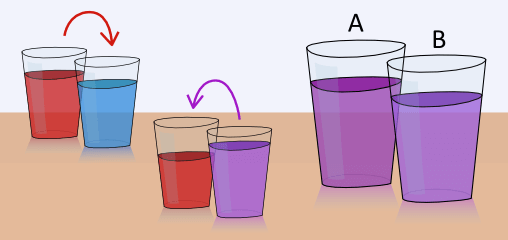
Question:
You have two drinks of the same size as on the left of the picture, A is red and B is blue. You take a spoonful from A and put it into B. After mixing
well, you take an equal spoonful from B and put it into A.
Which cup has the more contaminated mixture? In other words, does A have more blue in the mix, or does B have more red in the mix?
Answer: (click to show)
They are equally contaminated!
The logical reasoning
A spoonful is taken from and given to each cup, so they are the same size at the end. Any red liquid taken from
A must be in B, and so the same amount of blue liquid must have moved from B to A to make the amounts left equal.
The mathematical reasoning
say there is \(100\) units in each of A and B to start, and a spoonful is \(10\) units, these numbers are arbitrary. After the first swap,
A has \(90\) of red liquid, B has \(110\) of liquid, of which \(\frac{1}{11}\) is red.
After the second swap, A has
\[90+\frac{1}{11}\times 10 = 90 + \frac{10}{11}\]
of red, so
\[100-\left(90 + \frac{10}{11}\right)=9+\frac{1}{11}\]
of blue. B has
\[100-\frac{10}{11}\times 10 = 90 + \frac{10}{11}\]
of blue and
\[9+\frac{1}{11}\]
of red!
